

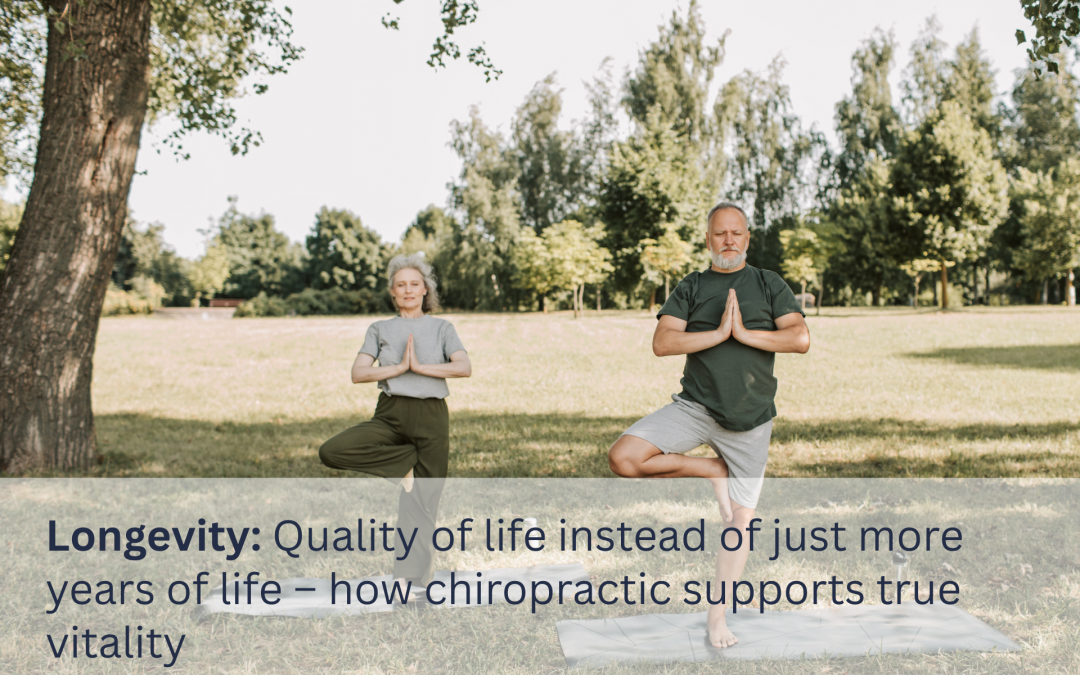
Longevity is one of the major health topics of our time. Yet while we are statistically living longer, a crucial question arises: How many of those years do we truly spend healthy, independent, and full of quality of life?
Modern medicine has succeeded in extending lifespan. What it has not yet adequately solved is the growing gap between lifespan and vitality. This is precisely where a new understanding of health begins – and where chiropractic care gains central importance.
Longevity Is More Than a Long Life
Longevity cannot be measured in years alone.
Many people spend a considerable portion of their lives with:
• chronic pain
• metabolic disorders
• persistent inflammation
• cognitive decline
• loss of mobility and independence
An extended life without mental clarity, emotional stability, and physical adaptability is not true longevity – it is merely prolonged time.
The true goal of longevity is quality of life.
Vitality: The Ability to Adapt
Healthy years of life mean being able, over the long term, to:
• think clearly
• move freely and safely
• not only manage stress, but recover from it
• respond flexibly to challenges
• actively participate in life
When these abilities diminish, additional years lose their value.
Why Aging Is Not a Single Process
Aging never occurs in isolation. It simultaneously affects multiple systems:
• The nervous system loses adaptability
• Muscles become weaker, coordination declines
• Metabolism becomes more sensitive
• Inflammation subsides more slowly
• Repair and regeneration processes slow down
• Emotional resilience decreases
• Social networks shrink
Each individual change may seem small – together, they determine how quickly we age.
Your Life – Your Responsibility
The traditional healthcare system usually intervenes only once symptoms or diseases are already present.
Longevity thinking asks a different question:
What influences my health long before disease develops?
This shift in perspective is subtle – but profound.
Why Many Longevity Strategies Are Underestimated
Sleep quality, stress regulation, exercise, nutrition, sunlight, social connection, cold and heat exposure, or intentional recovery are often considered “not evidence-based.”
Not because they are biologically ineffective – but because they are:
• difficult to patent
• unlikely to generate significant financial profit
• complex and highly individual in their effects
Large-scale studies are expensive. They are usually funded where economic returns are expected. This does not mean every measure is effective – but it explains why many valuable approaches remain in the gray area between clinical experience, observation, and early research.
Longevity Is Not an Extreme – It Is a Lifestyle
Longevity does not arise from short-term biohacks or radical interventions.
It develops through decisions that:
• fit into your daily life
• are sustainable long term
• remain mentally, physically, and emotionally viable
Perfection is not the goal. Direction is.
The Nervous System as the Key to Longevity
True vitality begins in the nervous system.
It regulates movement, metabolism, regeneration, stress processing, and emotional stability.
Stress is unavoidable.
What accelerates aging is stress without adequate recovery.
If the nervous system remains permanently in activation mode:
• repair processes are delayed
• sleep quality declines
• mental clarity decreases
• emotional resilience drops
HRV: A Window Into Adaptability
A measurable expression of this adaptability is heart rate variability (HRV).
It does not describe heart rate itself, but the subtle time intervals between individual heartbeats.
• High HRV: flexible adaptation, strong recovery
• Low HRV: persistent strain, limited recovery
HRV measurement during sleep is particularly meaningful – it reveals the nervous system’s baseline state.
Sleep: The Foundation of Cognitive Longevity
During sleep:
• the brain clears metabolic waste
• processes emotional experiences
• stabilizes memory and learning
Not only duration, but also rhythm is crucial.
A chronically disrupted day-night cycle reduces recovery quality – even with sufficient sleep time.
Chiropractic: Quality of Life Through Functional Regulation
Chiropractic care addresses precisely where longevity develops:
at the level of nervous system function and adaptability.
The goal is not symptom treatment, but supporting the systems that:
• coordinate movement
• process stress
• enable regeneration
• preserve quality of life over the long term
Chiropractic understands longevity not as a promise of eternal youth, but as an ongoing process of maintaining the ability to act, adapt, and regenerate over the years.
Conclusion: Longevity Begins Today
Longevity does not mean extending life at any cost.
It means increasing the number of years in which you:
• feel alive
• can think clearly
• move freely
• handle challenges – and recover from them
Quality of life instead of simply more years of life.
That is where longevity begins. Step by step.
👉 If you are currently experiencing pain and are looking for a sustainable solution, book an appointment on our website.
We wish you a vital and healthy life and are happy if our insights are helpful to you. If you would like to learn more about vitalistic American chiropractic, feel free to contact us. Discover our YouTube channel with valuable video content.
The Chirolounge Munich Team
Recent Comments